How Soon Will I Know if My Baby Has Downs or Autism
autism
Does My Child Have Autism?
Communicable autism early on makes a huge divergence. Past recognizing the early signs and symptoms, you can get your child the help they need to learn, abound, and thrive.
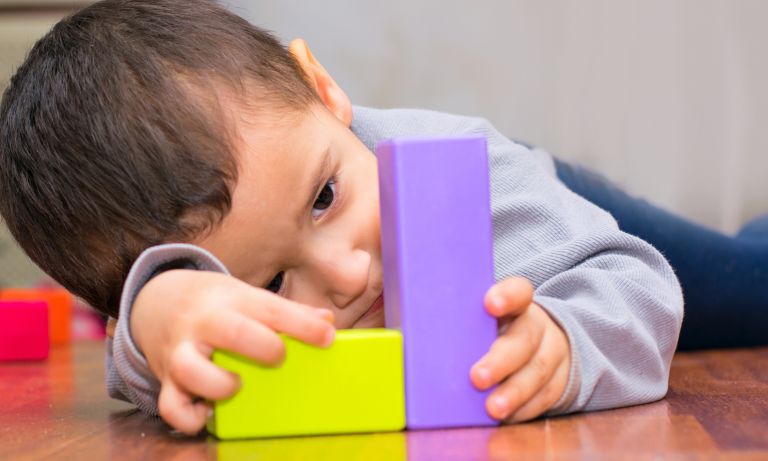
What is autism?
Autism expresses itself through a spectrum of symptoms. Autism spectrum disorder (ASD) appears in infancy and early babyhood, causing delays in many basic areas of evolution, such every bit learning to talk, play, and interact with others.
The signs and symptoms of autism vary widely, as practice its effects. Some children with autism have only mild impairments, while others have more obstacles to overcome. However, every child on the autism spectrum has problems, at least to some degree, in the following 3 areas:
- Communicating verbally and non-verbally.
- Relating to others and the world around them.
- Thinking and behaving flexibly.
At that place are unlike opinions amidst doctors, parents, and experts about what causes autism and how best to treat information technology. There is one fact, notwithstanding, that everyone agrees on: early and intensive intervention helps. For children at risk and children who show early signs, it can make all the deviation. Simply no matter your child'southward historic period, don't lose hope. Treatment tin can reduce the disorder's effects and assist your kid thrive in life.
One infant'south story
Melanie is a salubrious one-year old, but her parents are worried about her evolution because she's not doing many things that her older blood brother did at her historic period, like playing peek-a-boo and mimicking expressions and gestures. Melanie'due south mom and dad effort to engage her with toys, songs, and games, simply nothing they do gets her interest, allow lone a laugh or a smile. In fact, she rarely makes heart contact. And although her hearing has been checked and is normal, she doesn't babble, make other baby noises, or reply when her parents call her name. Melanie needs to be checked out past a child development specialist correct away.
How parents tin can spot the warning signs
As a parent, you're in the all-time position to spot the earliest warning signs of autism. You know your child better than anyone and find behaviors and quirks that a pediatrician, in a quick xv-minute visit, might non accept the hazard to see. Your kid'due south pediatrician can exist a valuable partner, only don't discount the importance of your own observations and experience. The primal is to brainwash yourself so you know what's typical and what's not.
[Read: Autism Spectrum Disorders]
Monitor your child's development. Autism involves a diverseness of developmental delays, so keeping a close eye on when—or if—your child is hitting the key social, emotional, and cognitive milestones is an effective manner to spot the problem early. While developmental delays don't automatically indicate to autism, they may signal a heightened chance.
Accept action if y'all're concerned. Every child develops at a unlike step, and then you don't need to panic if your child is a little late to talk or walk. When information technology comes to healthy development, there'southward a wide range of "typical." Merely if your kid is not meeting the milestones for his or her age, or you lot suspect a problem, share your concerns with your child's doctor immediately. Don't wait.
Don't take a wait-and-run into approach. Many concerned parents are told, "Don't worry" or "Look and see." But waiting is the worst thing you lot can do. You risk losing valuable time at an age where your child has the best chance for improvement. Furthermore, whether the filibuster is caused by autism or another factor, developmentally delayed kids are unlikely to simply "grow out of" their problems. In order to develop skills in an surface area of filibuster, your child needs extra assist and targeted handling.
Trust your instincts. Ideally, your kid's physician will have your concerns seriously and perform a thorough evaluation for autism or other developmental delays. Merely sometimes, even well-meaning doctors miss crimson flags or underestimate problems. Heed to your gut if it'south telling yous something is wrong, and exist persistent. Schedule a follow-upwardly appointment with the doctor, seek a 2d opinion, or inquire for a referral to a child development specialist.
Regression of whatsoever kind is a serious autism warning sign
Some children with autism spectrum disorder start to develop communication skills and then regress, usually betwixt 12 and 24 months. For example, a child who was communicating with words such every bit "mommy" or "upwardly" may stop using language entirely, or a child may stop playing social games he or she used to relish such every bit peek-a-boo, patty cake, or waving "farewell-good day." Whatsoever loss of speech, babbling, gestures, or social skills should exist taken very seriously, as regression is a major red flag for autism.
Signs and symptoms of autism in babies and toddlers
If autism is caught in infancy, treatment tin can take total advantage of the young brain'due south remarkable plasticity. Although autism is difficult to diagnose before 24 months, symptoms often surface between 12 and eighteen months. If signs are detected past 18 months of age, intensive treatment may aid to rewire the encephalon and reverse the symptoms.
[Read: Autism Treatments, Therapies, and Interventions]
The earliest signs of autism involve the absence of typical behaviors—non the presence of singular ones—so they tin can exist tough to spot. In some cases, the earliest symptoms of autism are even misinterpreted as signs of a "expert baby," since the infant may seem tranquility, independent, and undemanding. Nevertheless, you can catch warning signs early if you know what to wait for.
Some autistic infants don't respond to cuddling, reach out to exist picked up, or look at their mothers when existence fed.
Early signs
Your baby or toddler doesn't:
- Make centre contact, such as looking at you when being fed or smiling when being smiled at.
- Respond to their proper name, or to the sound of a familiar vocalization.
- Follow objects visually or follow your gesture when you point things out.
- Signal or wave goodbye, or use other gestures to communicate.
- Make noises to get your attention.
- Initiate or respond to cuddling or accomplish out to be picked up.
- Imitate your movements and facial expressions.
- Play with other people or share interest and enjoyment.
- Notice or care if y'all hurt yourself or experience discomfort.
Developmental red flags
The post-obit delays warrant an immediate evaluation past your child's pediatrician:
By 6 months: No big smiles or other warm, joyful expressions.
By 9 months: No dorsum-and-along sharing of sounds, smiles, or other facial expressions.
By 12 months: Lack of response to proper name.
By 12 months: No babbling or "baby talk."
By 12 months: No back-and-along gestures, such as pointing, showing, reaching, or waving.
By sixteen months: No spoken words.
By 24 months: No meaningful two-word phrases that don't involve imitating or repeating.
Signs and symptoms in older children
Equally children get older, the red flags for autism become more various. In that location are many warning signs and symptoms, but they typically revolve around dumb social skills, speech and language difficulties, non-verbal advice difficulties, and inflexible behavior.
Signs of social difficulties
- Appears disinterested or unaware of other people or what's going on around them.
- Doesn't know how to connect with others, play, or make friends.
- Prefers not to be touched, held, or cuddled.
- Doesn't play "pretend" games, engage in group games, imitate others, or use toys in creative ways.
- Has problem understanding feelings or talking virtually them.
- Doesn't seem to hear when others talk to them.
- Doesn't share interests or achievements with others (drawings, toys).
Basic social interaction can be hard for children with autism spectrum disorder. Many kids on the autism spectrum seem to prefer to live in their own globe, aloof and detached from others.
Signs of oral communication and language difficulties
- Speaks in an atypical tone of voice, or with an odd rhythm or pitch (due east.g. ends every judgement as if asking a question).
- Repeats the aforementioned words or phrases over and over, ofttimes without chatty intent.
- Responds to a question by repeating it, rather than answering information technology.
- Uses linguistic communication incorrectly (grammatical errors, incorrect words) or refers to him or herself in the 3rd person.
- Has difficulty communicating needs or desires.
- Doesn't understand simple directions, statements, or questions.
- Takes what is said besides literally (misses undertones of humour, irony, and sarcasm).
Children with autism spectrum disorder have difficulty with spoken language and language. Ofttimes, they starting time talking late.
Signs of nonverbal communication difficulties
- Avoids centre contact.
- Uses facial expressions that don't lucifer what they are proverb
- Doesn't pick upward on other people's facial expressions, tone of voice, and gestures.
- Makes very few gestures (such every bit pointing). May come across as cold or "robot-similar."
- Reacts unusually to sights, smells, textures, and sounds. May be specially sensitive to loud noises. Can likewise exist unresponsive to people entering/leaving, as well every bit efforts by others to attract the kid'due south attention.
- Atypical posture, clumsiness, or eccentric ways of moving (e.one thousand., walking exclusively on tiptoe).
Children with autism spectrum disorder have trouble picking up on subtle nonverbal cues and using body language. This makes the "requite-and-take" of social interaction very difficult.
Signs of inflexibility
- Follows a rigid routine (e.thousand., insists on taking a specific road to school).
- Has difficulty adapting to whatever changes in schedule or environment (east.g., throws a tantrum if the piece of furniture is rearranged or bedtime is at a different time than usual).
- Unusual attachments to toys or foreign objects such as keys, calorie-free switches, or safe bands. Obsessively lines things upwardly or arranges them in a certain guild.
- Preoccupation with a narrow topic of interest, often involving numbers or symbols (e.g., memorizing and reciting facts about maps, train schedules, or sports statistics).
- Spends long periods watching moving objects such as a ceiling fan, or focusing on i specific part of an object such every bit the wheels of a toy automobile.
- Repeats the aforementioned deportment or movements over and over again, such equally flapping easily, rocking, or twirling (known as self-stimulatory behavior, or "stimming"). Some researchers and clinicians believe that these behaviors may soothe children with autism more than stimulate them.
Children with autism spectrum disorder are often restricted, inflexible, and even obsessive in their behaviors, activities, and interests.
Common restricted and repetitive behaviors
- Hand flapping
- Rocking dorsum and forth
- Spinning in a circumvolve
- Finger flicking
- Head banging
- Staring at lights
- Moving fingers in front of the eyes
- Snapping fingers
- Tapping ears
- Scratching
- Lining upwards toys
- Spinning objects
- Cycle Spinning
- Watching moving objects
- Flicking calorie-free switches on and off
- Repeating words or noises
Causes of autism
Until recently, near scientists believed that autism is caused mostly by genetic factors. Simply groundbreaking new research indicates that environmental factors may also exist important in the development of autism.
Babies may be born with a genetic vulnerability to autism that is and so triggered by something in the external environment, either while he or she is even so in the womb or one-time subsequently birth.
It's important to notation that the environment, in this context, means anything outside the torso. It's not limited to things like pollution or toxins in the atmosphere. In fact, one of the about important environments appears to be the prenatal environment.
Prenatal factors that may contribute to autism
Taking antidepressants during pregnancy, peculiarly in the starting time 3 months.
Nutritional deficiencies early in pregnancy, particularly not getting enough folic acid.
The age of the mother and begetter.
Complications at or before long after birth, including very low birth weight and neonatal anemia
Maternal infections during pregnancy.
Exposure to chemic pollutants, such as metals and pesticides, while pregnant.
More inquiry on these prenatal risk factors is needed, but if you're pregnant or trying to conceive, it can't injure to take steps now to reduce your baby's risk of autism.
Reducing the risk of autism: Tips for expectant mothers
Have a multivitamin. Taking 400 micrograms of folic acid daily helps prevent birth defects such as spina bifida. Information technology'south not clear whether this volition too help reduce risk of autism, simply taking the vitamins can't injure.
Enquire about SSRIs. Women who are taking an SSRI (or who develop depression during pregnancy) should talk with a clinician well-nigh all the risks and benefits of these drugs. Untreated depression in a female parent can also bear upon her kid's well-beingness later on, and then this is not a uncomplicated decision to make.
Practice prenatal care. Eating nutritious nutrient, trying to avoid infections, and seeing a clinician for regular check-ups can increment the chances of giving birth to a healthy child.
Source: Harvard Health Publications
Autism and vaccines
While you can't control the genes your child inherits, or shield him or her from every environmental danger, there is one very of import thing you tin can do to protect the health of your child: make certain he or she is vaccinated on schedule.
Despite a lot of controversy on the topic, scientific research does not support the theory that vaccines or their ingredients cause autism. Five major epidemiologic studies conducted in the U.S., UK, Sweden, and Kingdom of denmark, constitute that children who received vaccines did not have higher rates of autism. Additionally, a major condom review past the Institute of Medicine failed to find whatever bear witness supporting the connexion. Other organizations that have concluded that vaccines are not associated with autism include the Centers for Illness Control and Prevention (CDC), the U.Southward. Food and Drug Administration (FDA), the American Academy of Pediatrics, and the World Wellness Organization (WHO).
| Myths and facts about childhood vaccinations |
| Myth: Vaccines aren't necessary. Fact: Vaccines protect your child from many serious and potentially mortiferous diseases, including measles, meningitis, polio, tetanus, diphtheria, and whooping cough. These diseases are uncommon today because vaccines are doing their job. But the bacteria and viruses that crusade these diseases still exist and can be passed on to children who aren't immunized. |
| Myth: Vaccines cause autism. Fact: Despite extensive research and safety studies, scientists and doctors have non found a link between childhood vaccinations and autism or other developmental problems. Children who are non vaccinated exercise non accept lower rates of autism spectrum disorders. |
| Myth: Vaccines are given too early. Fact: Early vaccination protects your child from serious diseases that are most likely to occur—and about dangerous—in babies. Waiting to immunize your baby puts him or her at risk. The recommended vaccination schedule is designed to work best with children'southward immune systems at specific ages. A different schedule may not offering the same protection. |
| Myth: Besides many vaccines are given at once. Fact: You may take heard theories that the recommended vaccine schedule overloads immature children'due south allowed systems and may even cause autism. But enquiry shows that spacing out vaccinations doesn't improve children'due south health or lower their risk of autism, and equally noted in a higher place, really puts them at risk for potentially fatal diseases. |
Affordable Online Therapy
Become professional help from BetterHelp's network of licensed therapists.
HelpGuide is reader supported. We may receive a commission if you sign up for BetterHelp through the provided link. Larn more.
What to do if you lot're worried
If your child is developmentally delayed, or if you've observed other red flags for autism, schedule an appointment with your pediatrician correct away. In fact, it'southward a skilful idea to have your child screened by a doc even if he or she is hitting the developmental milestones on schedule. The American Academy of Pediatrics recommends that all children receive routine developmental screenings, besides equally specific screenings for autism at ix, 18, and thirty months of historic period.
Schedule an autism screening. A number of specialized screening tools have been developed to identify children at risk for autism. Most of these screening tools are quick and straightforward, consisting of yes-or-no questions or a checklist of symptoms. Your pediatrician should likewise get your feedback regarding your kid's behavior.
[Read: Helping Your Child with Autism Thrive]
See a developmental specialist. If your pediatrician detects possible signs of autism during the screening, your child should be referred to a specialist for a comprehensive diagnostic evaluation. Screening tools tin can't be used to brand a diagnosis, which is why further cess is needed. A specialist tin can acquit a number of tests to determine whether or not your child has autism. Although many clinicians will not diagnose a child with autism before 30 months of age, they will be able to employ screening techniques to decide when a cluster of symptoms associated with autism is present.
Seek early intervention services. The diagnostic procedure for autism is tricky and can sometimes accept a while. But you tin can take advantage of treatment as presently as yous doubtable your kid has developmental delays. Inquire your doctor to refer you to early intervention services. Early intervention is a federally funded plan for infants and toddlers with disabilities. Children who demonstrate several early alert signs may have developmental delays. They volition do good from early intervention whether or non they encounter the full criteria for an autism spectrum disorder. In other words, there is more hazard involved in the expect-and-encounter approach than in receiving early on intervention.
Ted Hutman, Ph.D. is Assistant Clinical Professor in Psychiatry at the David Geffen School of Medicine at UCLA and a licensed clinical psychologist practicing in Santa Monica, CA.
How Soon Will I Know if My Baby Has Downs or Autism
Source: https://www.helpguide.org/articles/autism-learning-disabilities/does-my-child-have-autism.htm
0 Response to "How Soon Will I Know if My Baby Has Downs or Autism"
Post a Comment